

Have you seen the latest reversal of climate change? This time, it’s from Bill Gates, who has sought forgiveness for when he toured the globe evangelizing his climate alarmism, “How to Avoid Climate Disaster.” He came out yesterday with his newest essay on the issue, “Three Tough Truths About Climate.” He does this just ahead of the upcoming COP30 in Brazil.
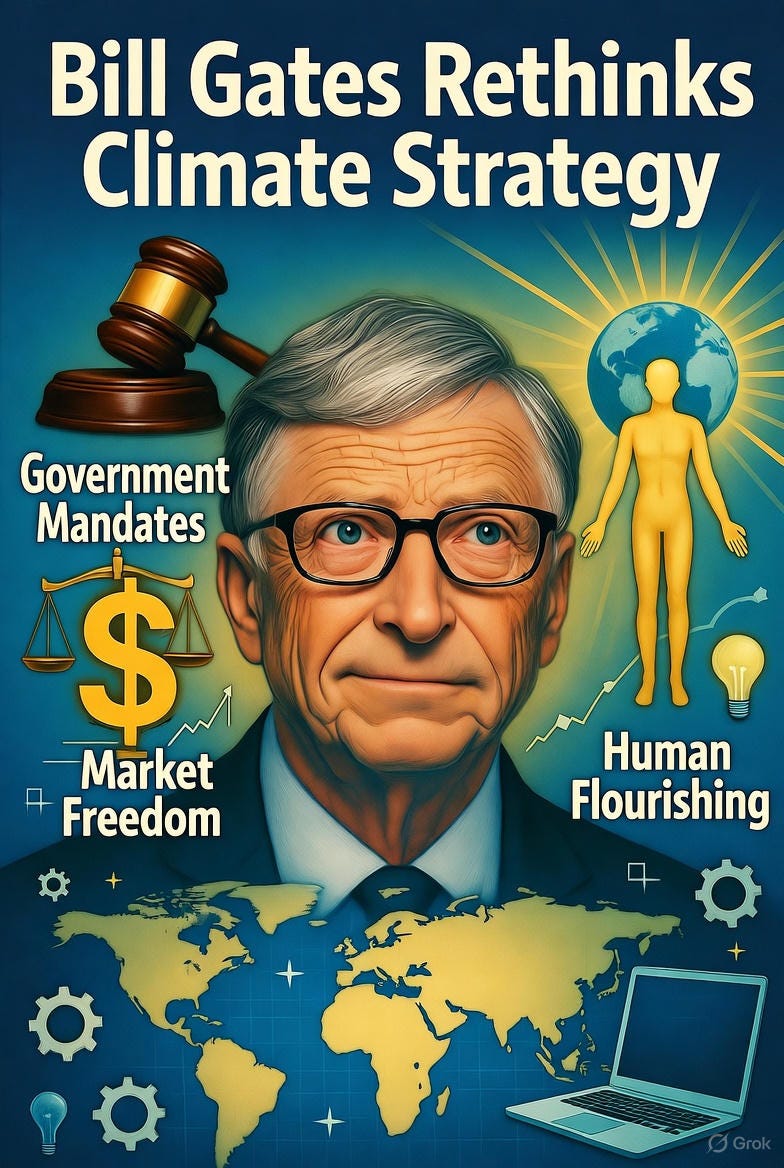
In his new proposal, Gates suggests reframing and refocusing on human welfare over rigid emission cuts and temperature targets. Now this, in my view, is still flawed, though now he is lessening government mandates in favor of voluntary “solutions” through foundations and other private philanthropy.
Gates’ truth 1 is about how climate change will not bring about the apocalyptic narratives he, Al Gore, and other zealots promoted in the past. No shit, Sherlock. I mean, they had no choice but to come out with this admission, as history has not been on their side, as nearly all their predictions have failed to come true. Instead, free-market incentives for private R&D (think voluntary investments, not UN dictates) would accelerate breakthroughs.
Gates’ truth 2 suggests refocusing on human suffering over reducing CO2 emissions. He suggests focusing on alleviating poverty, prioritizing health, and economic growth for poor countries. Perhaps we’ll see an end to the government-forced “net-zero” timelines that ignore public choice theory—politicians chase votes with virtue-signaling regs that hurt the vulnerable most.
Gates’ third truth suggests that global temperatures are not the best progress metric. Instead, he suggests that finding welfare improvement would outweigh strict warming limits, and he advocates for cheap clean tech via “Green Premiums” reductions. Now, while I see he is suggesting massive government involvement in this third truth, I would posit that true progress comes from deregulated markets where entrepreneurs compete freely, not subsidized schemes or international accords that enable cronyism.
It is good to see Gates’ realization that emission-obsessed mandates are not only a burden on taxpayers and poor countries, but they do not work. It is refreshing to see him finally suggest getting rid of government involvement, for the most part, in favor of voluntary, market-based approaches. Something that others have been suggesting for decades.